17-2-2018
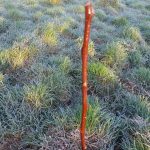
About a month after planting, the new apple tree doesn’t show any signs of growth yet. While we patiently wait for development, let’s look at some background knowledge about apple trees.
Most of the apple trees we find in our gardens and orchards have been grafted. That means a specific apple variety (such as Braeburn, Discovery, James Grieve etc.) has been grafted onto a different rootstock. In a way, two different plants with different characteristics have been made into one plant with the best characteristics of both original plants. While the root stock determines how tall the tree will grow and how early or late it will start fruiting, the graft determines size, colour and taste of the fruit.
For example, a Braeburn graft on an M26 root stock will become a small tree which will produce red, juicy, crisp apples that keep well through the winter. A James Grieve graft on an MM106 rootstock will become a medium sized tree bearing yellow-orange, soft apples that don’t keep but make great apple sauce.
Weaker rootstocks are great for small gardens. They grow into small trees that fruit early and are easily harvested from the ground. Stronger rootstocks are great for large orchards where space is available and animals might graze underneath the trees.
Some of the various rootstocks:
M27 – weak rootstock, needs staking, small tree, large fruit, needs good soil.
M9 – weak rootstock needs staking, fruits early, large fruit, heavy crop.
M26 – stronger than M27 and M9, needs staking, good size and quality of fruit.
MM106 – medium strength rootstock, good root system, can tackle poor ground, good fruit quality.
MM111 – stronger rootstock, can tackle various conditions, takes longer to fruit.