Category Archives: Uncategorized

Autumn Coming

17-9-2018
Autumn is moving closer. Next weekend, we’ll experience the autumnal equinox when days and nights will be of equal length. The weather has changed, even though days are still mild and often enough sunny.

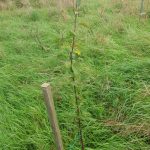
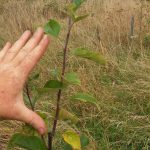
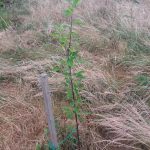
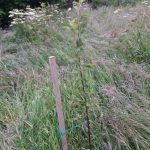
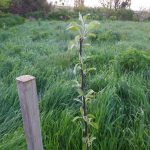
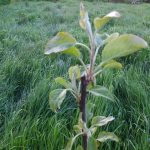
There’s not much to report about the young apple tree. It is standing strong and tall, ready to face the autumn winds.

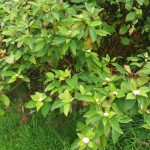
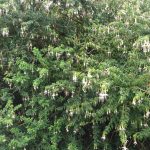
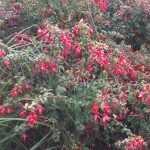
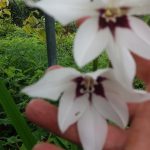
The Dogwood shrub (Cornus sanguinea) has decided to send out a second flush of sweetly scented flowers. Fuchsia are flowering extremely well, and one Acidanthera plant has made a late effort and pushed out beautiful flowers.

Now is a good time to start planting bulbs for spring flowers, like daffodils, tulips, crocus, iris, snake’s head fritillary etc. If you’re not sure how and what, give me a call!


Apples!

19-8-2018
Mid July to mid August have seen beautiful summer weather. Sunshine, warm weather, some rain, some clouds, some mist. The apple tree is doing well, growing slowly but surely.
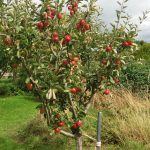
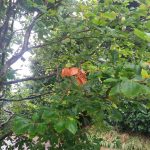
Meanwhile, it’s older sister tree is producing masses of red apples which are almost ready to eat!

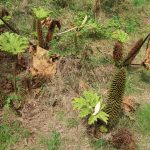
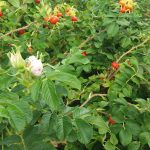
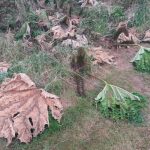
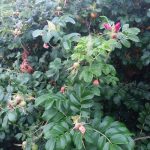
The Gunnera plant has survived the drought and is recovering nicely. The Potato Rose (Rosa rugosa) is still flowering and still producing new flower buds.


Irish Drought

15-7-2018
More difficulty! The weather changed from cold and wet to hot and dry fairly suddenly mid-May. Now Ireland is experiencing a drought, including hosepipe ban, and high temperatures. The usual cloud cover is gone most days.
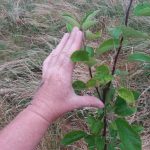
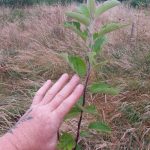
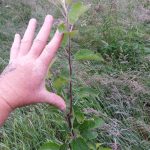
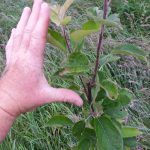
Yet, the apple tree is unfazed by these weather conditions. Its leaves are green and in good shape. The side shoot hasn’t grown in the past month, but the main shoot has. Not by much, but still!
This is due to apical dominance, one of the laws of tree growth. The top bud (also called apical bud) gets to grow the strongest, as it is the one to bring the tree towards the light. Light is necessary for photosynthesis, the tree’s way of producing energy. Side shoots don’t grow quite as strongly. Certainly in times of hardship (such as drought), energy is conserved and used mainly for survival.

Different plants have different ways of conserving energy. You may have noticed that some trees, while green and strong overall, have a few dried out twigs hanging down.
Other plants shed most of their leaves altogether in order to keep their core parts alive.
Yet others, who are strong enough to keep going, extend their flowering period to ensure seed production and hence survival.

Today’s rainy weather is a blessing.

Photos: Apple tree; side shoot same length as one month ago; main shoot slightly longer than one month ago; Beech (Fagus sylvatica) drying out some twigs; Gunnera tinctoria shedding leaves; Potato Rose (Rosa rugosa) still producing flower buds while already forming rose hips.


Gaining Shape

18-6-2018
The apple tree is standing strong among tall weeds and has braved not only the long winter, but also hot temperatures and a good number of long dry sunny days in a row.
The main shoot is stretching and a side shoot is starting to look like a branch.

Photos: Apple tree; main shoot more than 20cm long; side shoot about 20cm long.


Stretching

18-5-2018
After a long and difficult winter, the young apple tree has opened its leaves and started growing. The top bud is forming a strong shoot that stretches toward the sky.
Apple trees are covered in masses of flowers everywhere. Go there and smell the beautiful scent!


Time to Unfold

16-4-2018
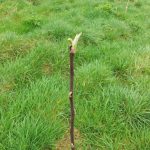
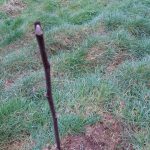
Halfway through April, the young apple tree is finally unfolding its first leaves.
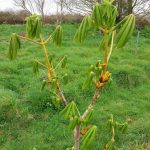
Meanwhile, the Horse Chestnut is making good headway.
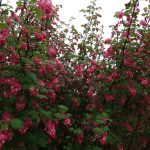
Flowering Currant is flowering beautifully and providing food for bees and bumble bees.
Yesterday’s mild rain has brought many changes to nature, a quickening and greening is visible everywhere.
Don’t lose heart!

Photos: Apple tree; Horse Chestnut (Aesculus hippocastanum); Flowering Currant (Ribes sanguineum).


Bud Action

19-3-2018
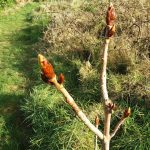
Two month after planting, the young Braeburn apple tree is showing the tiniest signs of life. If you look very closely, you can see the top bud reddening and fattening a little bit. The tree got through the snow alright and is currently mastering another cold spell.
Meanwhile, the sticky buds of the chestnut tree are swelling impressively, while some trees, like the wild plum, are past the bud stage. Their leaves are already out, in spite of snow and frost.
If you’re out and about in town and country, look out for the clouds of pink and white flowers on ornamental cherries and plums. Their flowers appear before the leaves, and now is the time to admire them.

Photos: Apple tree; Horse Chestnut (Aesculus hippocastanum).


Rootstock and Graft

17-2-2018
About a month after planting, the new apple tree doesn’t show any signs of growth yet. While we patiently wait for development, let’s look at some background knowledge about apple trees.

Most of the apple trees we find in our gardens and orchards have been grafted. That means a specific apple variety (such as Braeburn, Discovery, James Grieve etc.) has been grafted onto a different rootstock. In a way, two different plants with different characteristics have been made into one plant with the best characteristics of both original plants. While the root stock determines how tall the tree will grow and how early or late it will start fruiting, the graft determines size, colour and taste of the fruit.
For example, a Braeburn graft on an M26 root stock will become a small tree which will produce red, juicy, crisp apples that keep well through the winter. A James Grieve graft on an MM106 rootstock will become a medium sized tree bearing yellow-orange, soft apples that don’t keep but make great apple sauce.
Weaker rootstocks are great for small gardens. They grow into small trees that fruit early and are easily harvested from the ground. Stronger rootstocks are great for large orchards where space is available and animals might graze underneath the trees.
Some of the various rootstocks:
M27 – weak rootstock, needs staking, small tree, large fruit, needs good soil.
M9 – weak rootstock needs staking, fruits early, large fruit, heavy crop.
M26 – stronger than M27 and M9, needs staking, good size and quality of fruit.
MM106 – medium strength rootstock, good root system, can tackle poor ground, good fruit quality.
MM111 – stronger rootstock, can tackle various conditions, takes longer to fruit.


Braeburn Apple Tree

15-1-2018
A new year – a new project! Aphrodite’s Gardens is back in action and would like to introduce project “Braeburn Apple Tree”. The idea is to follow a young apple tree from the day of planting onward and to watch how it develops during the seasons and years.
Braeburn is my favourite apple variety, and I recently acquired a Braeburn tree from Future Forests.
It’s a 1 year old tree, grafted on an M26 root stock. More about grafts and root stocks will follow in another post.
1 year old means it’s a very young tree and there’s not much to see so far. And yet, it’s a tree with all the potential to grow leaves, side shoots, branches – and apples – in the years to come.

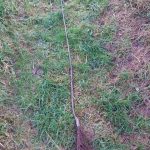
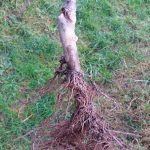
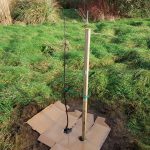
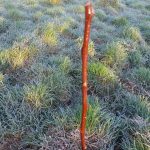
Photos: Tree before planting; the area on the stem were the tree was grafted; planted tree.